Creating Dimensional Architectural Facades
From concrete and glass to fabric and 3D printing—key materials in non-standard architecture. Let’s explore a variety of facade cladding options through inspiring examples of dimensional, sculptural building exteriors.
April 3, 2025
What do the spaceship-like DDP, the flowing lines of the Louis Vuitton Maison inspired by traditional Korean crane dance, and the octopus-sucker-like curves of Hana Place 1 in Samseong-dong all have in common? Their eye-catching forms aren’t just about aesthetics—they’re the result of advanced structural design and innovative materials. To build a dynamic and sculptural façade, you need both engineering ingenuity and cladding materials that allow for freedom of form.
From concrete and glass—two staples of non-standard architecture—to lightweight fabrics and reality-bending 3D printing, let’s explore some of the most moldable façade materials through bold architectural case studies.
Creating Dimensional Architectural Facades
UHPC & GFRC
Glass
Fabric
Clay – 3D Printing
1. UHPC & GFRC
Completed in 2017, The System Lab’s Hana Bank PLACE 1 drew attention for its radical façade, which featured a series of non-standard, suction-cup-like shapes inspired by an octopus. The material used? UHPC—Ultra High Performance Concrete. Marketed at the time as "super concrete," UHPC’s strength lies in its ability to form complex shapes without the need for rebar. It’s significantly stronger than conventional concrete—over 10 times more, in fact—and can be cast in thinner sections, making it a game-changer in architectural design.
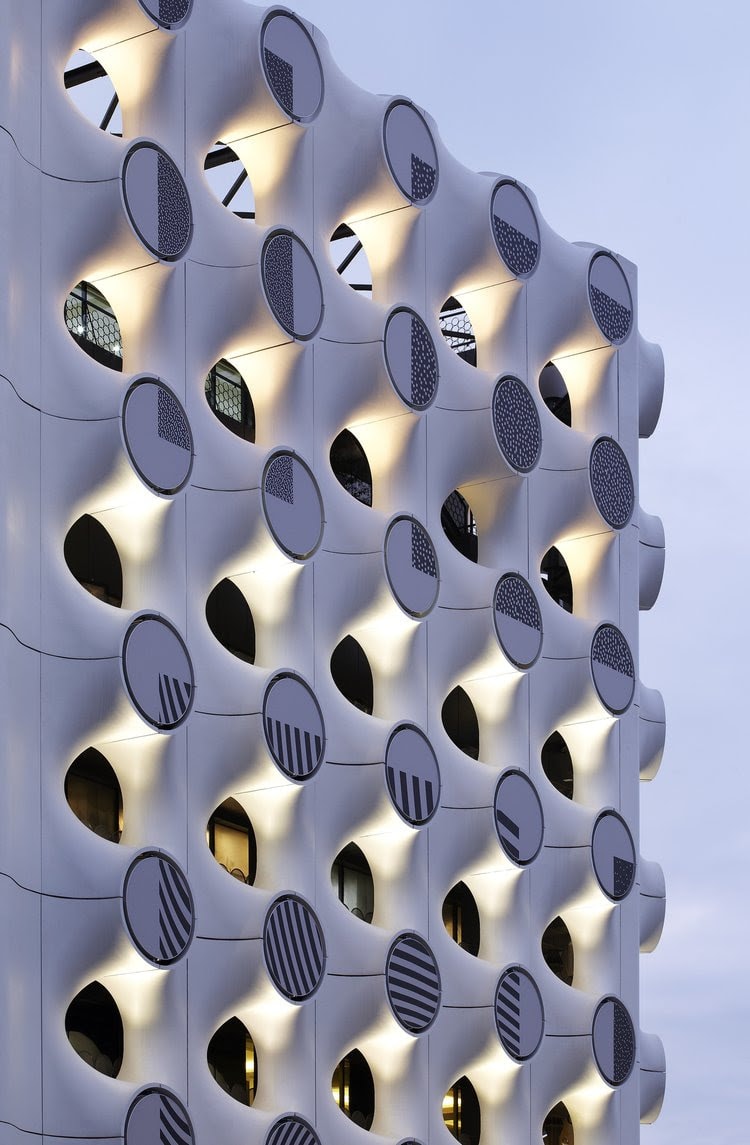
The building’s façade was constructed using UHPC modules prefabricated in a factory and installed on-site. Each 3D-shaped unit contained kinetic art discs, giving the structure a dynamic, animated presence.
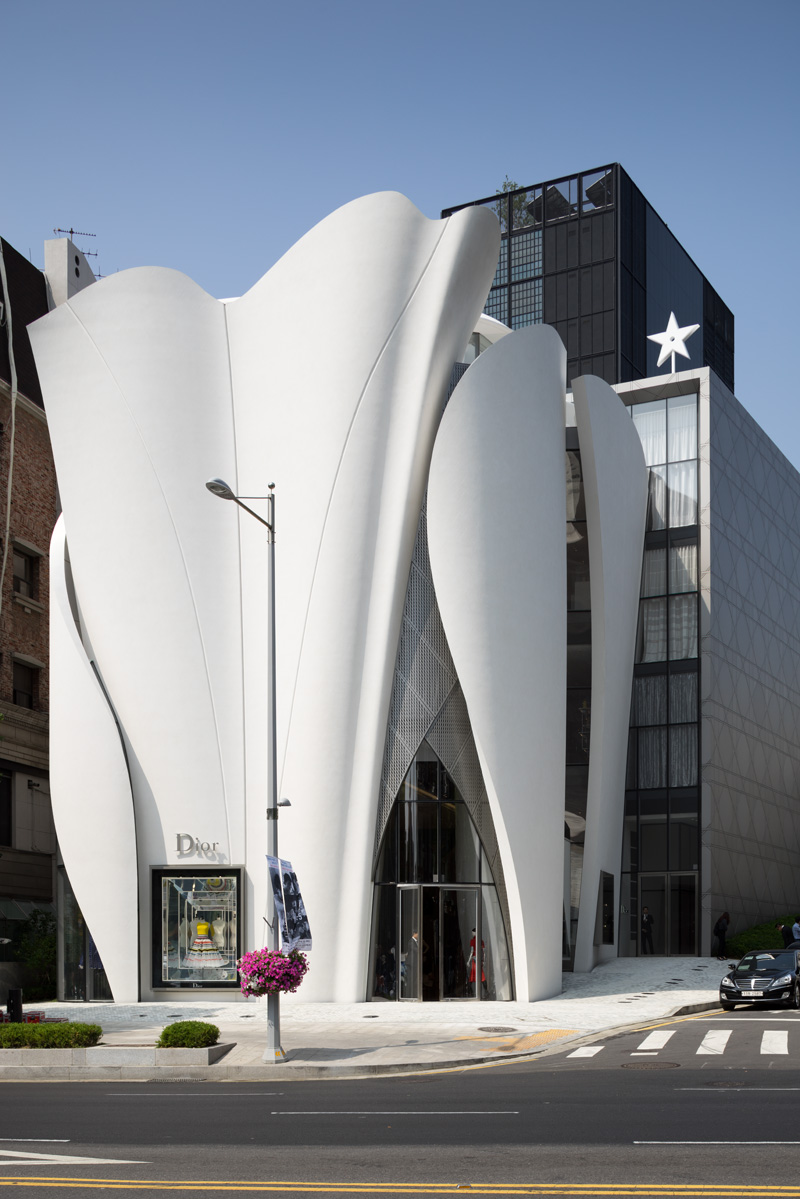
Before UHPC, GFRC (Glass Fiber Reinforced Concrete) was already popular for complex forms. This lightweight yet durable material is ideal for freeform applications. A perfect example is the House of Dior in Cheongdam, where its petal-like façade was crafted using GFRC. (See behind-the-scenes photos for the production process.)
2. Glass
When Heatherwick Studio announced the renovation of The Galleria last year, the spotlight was on its wave-like curved glass façade. Although glass is often perceived as flat due to its frequent use in curtain walls, it’s actually a highly sculptural material. With the right mold, glass can be formed into waves, folds, or other dimensional forms—just like concrete.
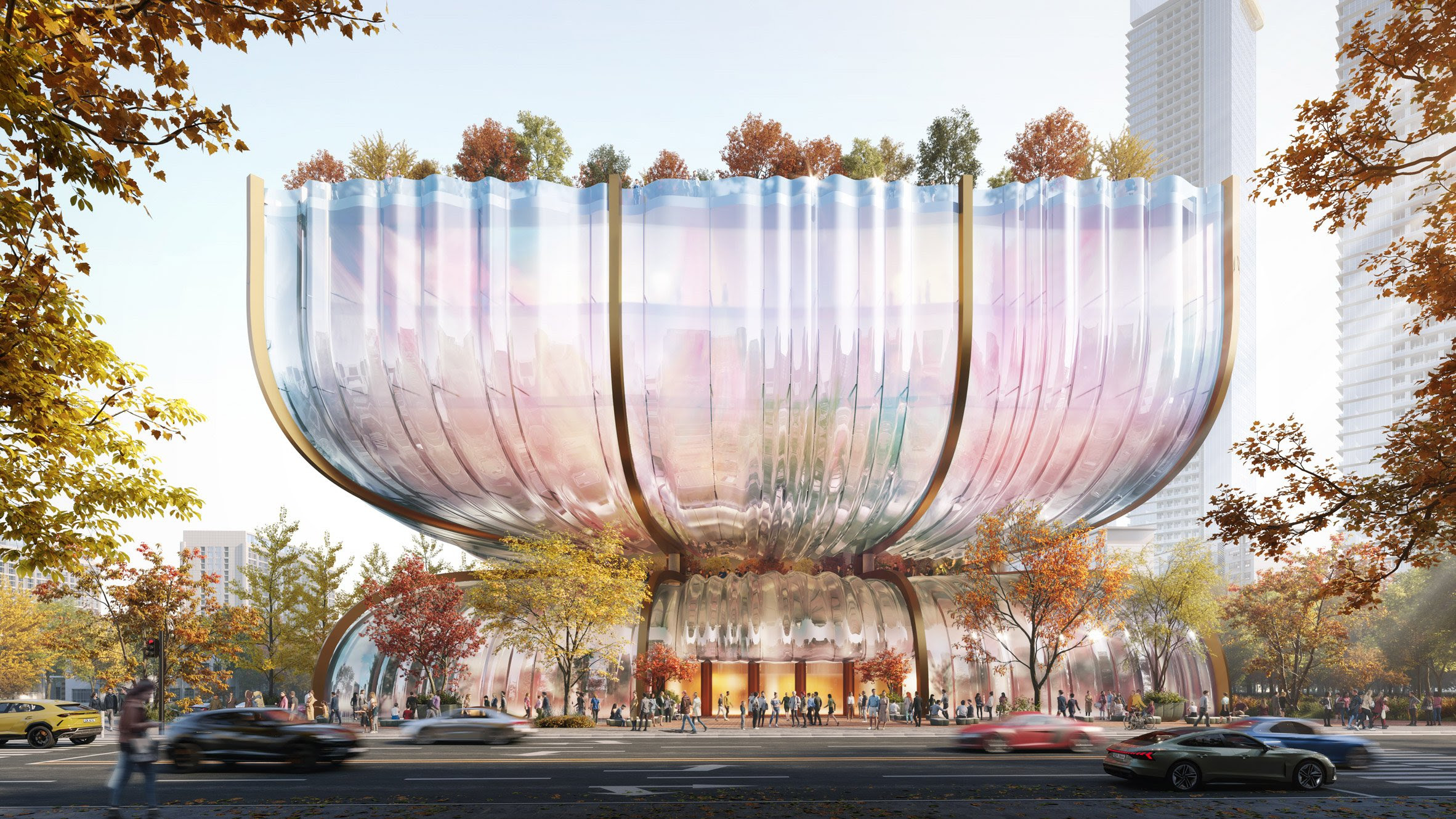
The new Galleria design is said to resemble an hourglass, featuring soft undulating curves made of ripple-shaped glass. At night, the façade doubles as a media surface, with light and video projections adding another layer of storytelling.
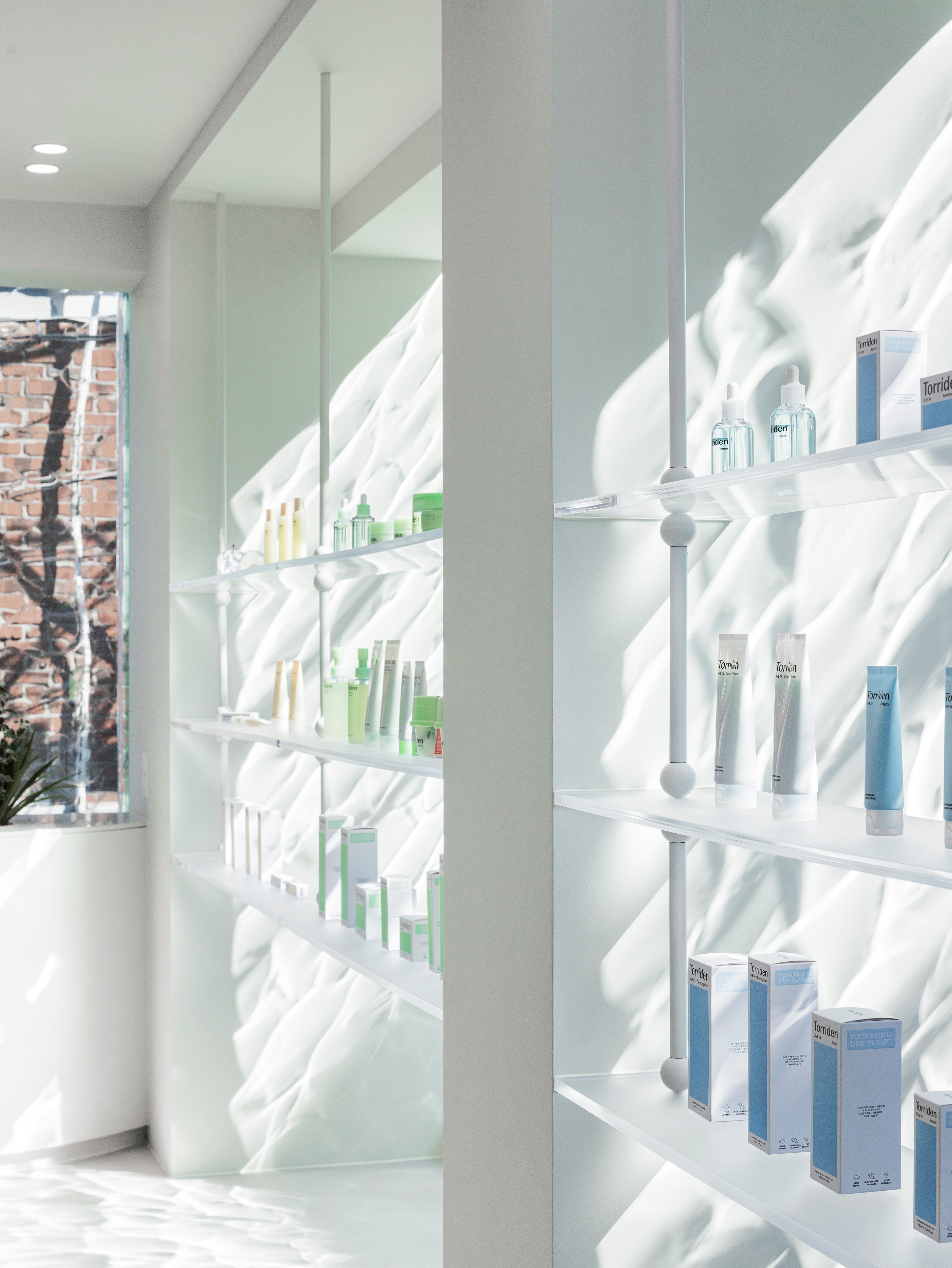
Another local example is Torriden Seongsu, where randomly rippled glass panels create a dramatic silhouette. Their irregular surface interacts beautifully with light and reflections, giving the space a dynamic and emotionally rich presence. For more on this project, see our feature: “Torriden Seongsu’s Spatial Design: What Materials Shaped Its Brand Identity?”
3. Fabric
Unlike concrete or glass, fabric allows for far more flexible and cost-effective shaping. Though it can’t serve as a structural component, it works wonderfully as a second skin—especially in renovations. Compared to metal mesh or metal fabrics, it’s lighter, cheaper, and easier to experiment with.
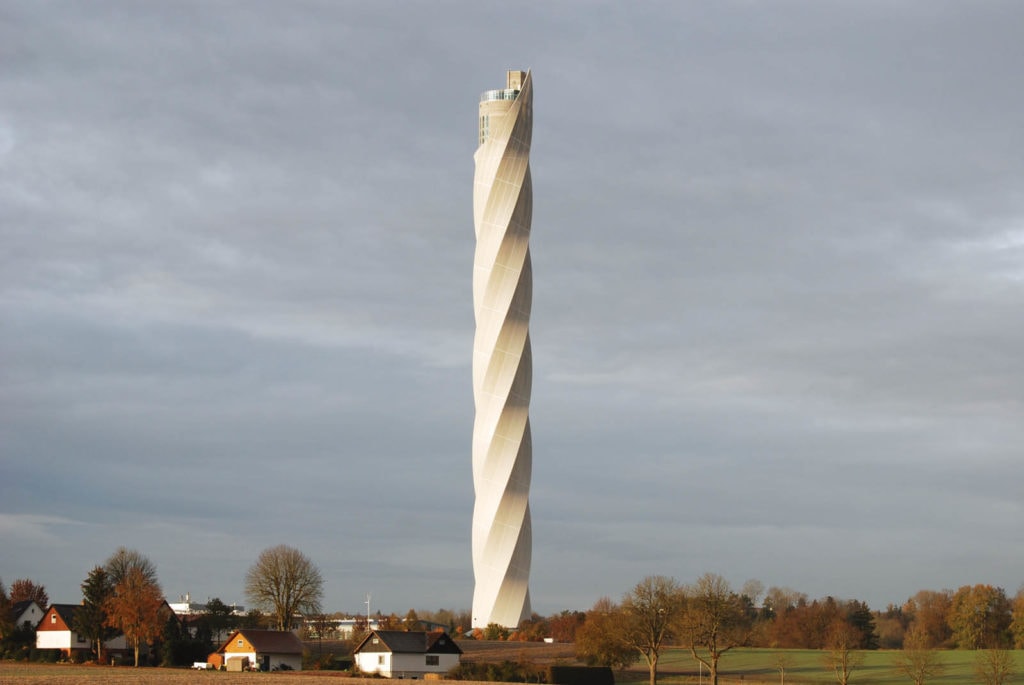
Take the Thyssenkrupp Test Tower, for example. The spiral-shaped exterior wraps around the concrete structure like a twisted ice pop. Designed to withstand the high altitudes and weather of a super-tall tower, the fabric skin enhances both durability and performance.
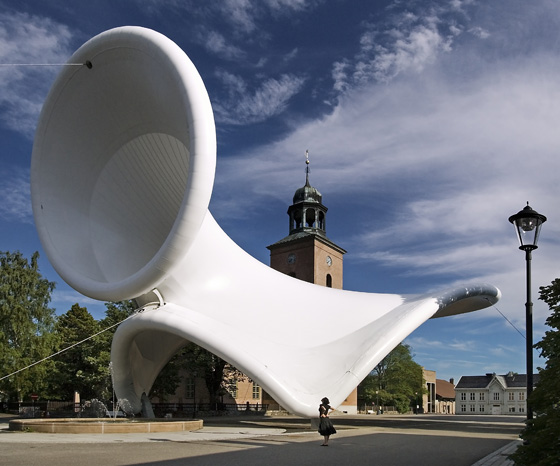
Then there’s Tubaloon by Snøhetta—a sculptural pavilion for a jazz festival. Using membrane structure techniques, the team designed an organic form that could be easily assembled and disassembled. The material used was a PES woven fabric with a PVC coating, chosen for its durability, sound performance, and ability to support projections. You can dive deeper into fabric types and examples on our “Mixtape” section.
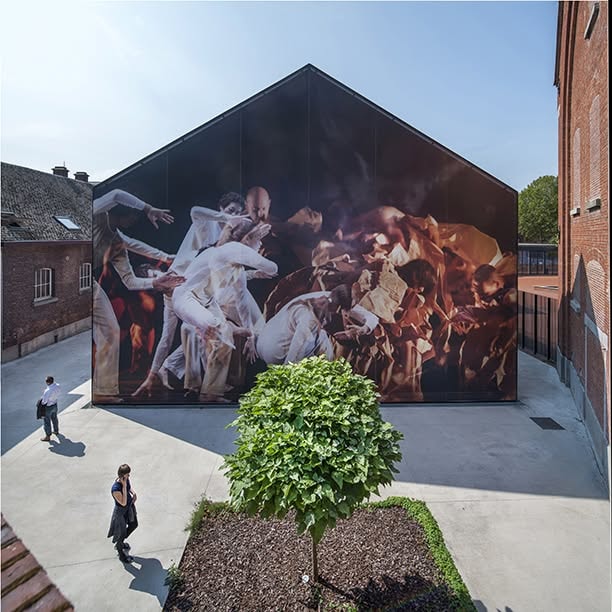
Another big advantage of fabric? Easy customization. You can print virtually any graphic onto the surface. Combined with its light permeability, this opens up the door to stunning visual effects—almost like a media façade.
4. 3D Printing
3D printing in architecture is advancing fast. After small homes in France, the Netherlands, and Belgium were successfully printed, the technology is now expanding to entire housing developments—and even future space habitats. Most construction printing still uses concrete, but materials like earth and plastic are also gaining traction.
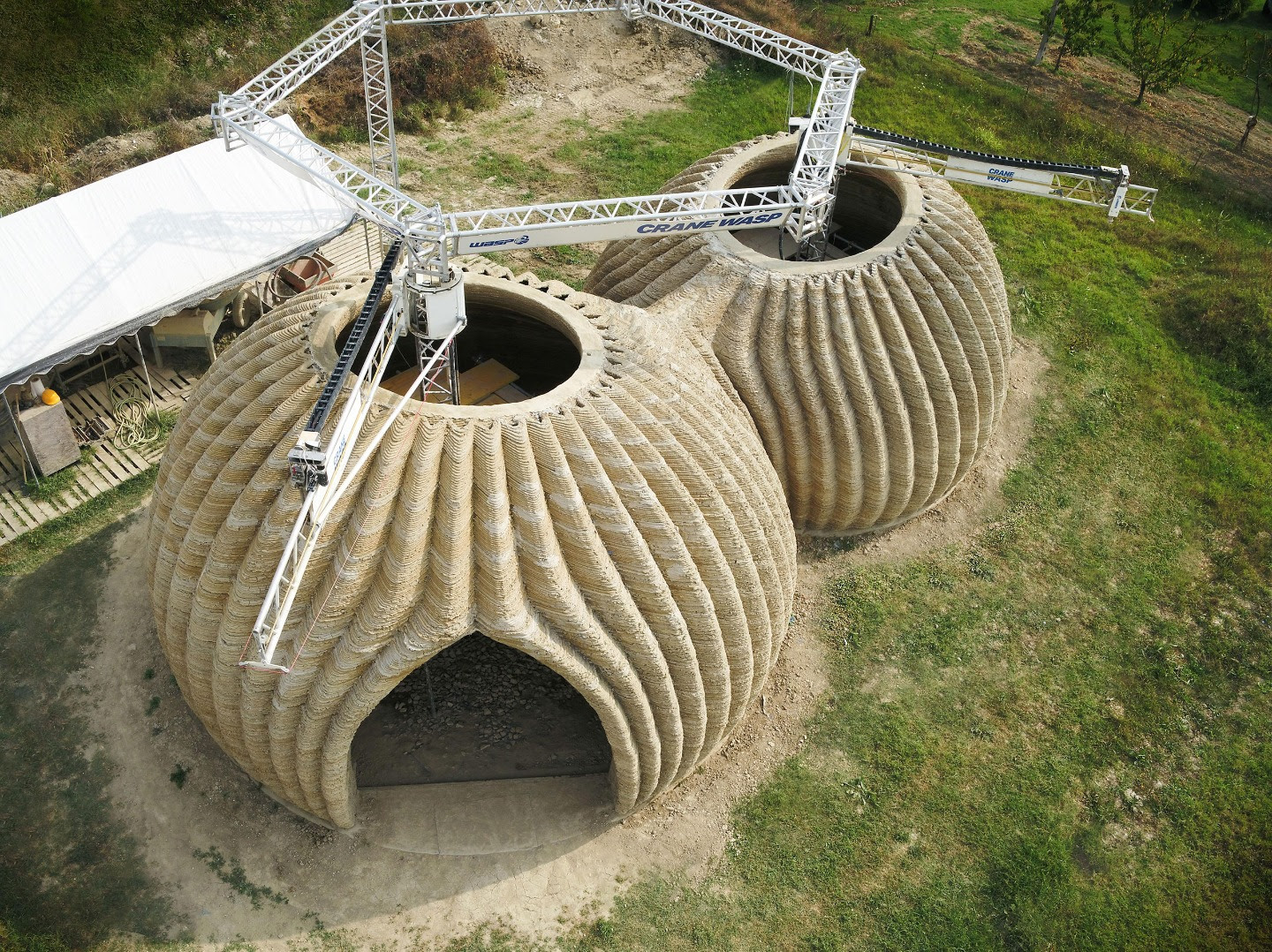
One remarkable case is TECLA, a collaboration between Italian 3D printing company WASP and architect Mario Cucinella. Using a giant crane-3D printer and locally sourced earth, the team drastically reduced construction time and labor costs. It’s a brilliant example of both sustainability and innovation.
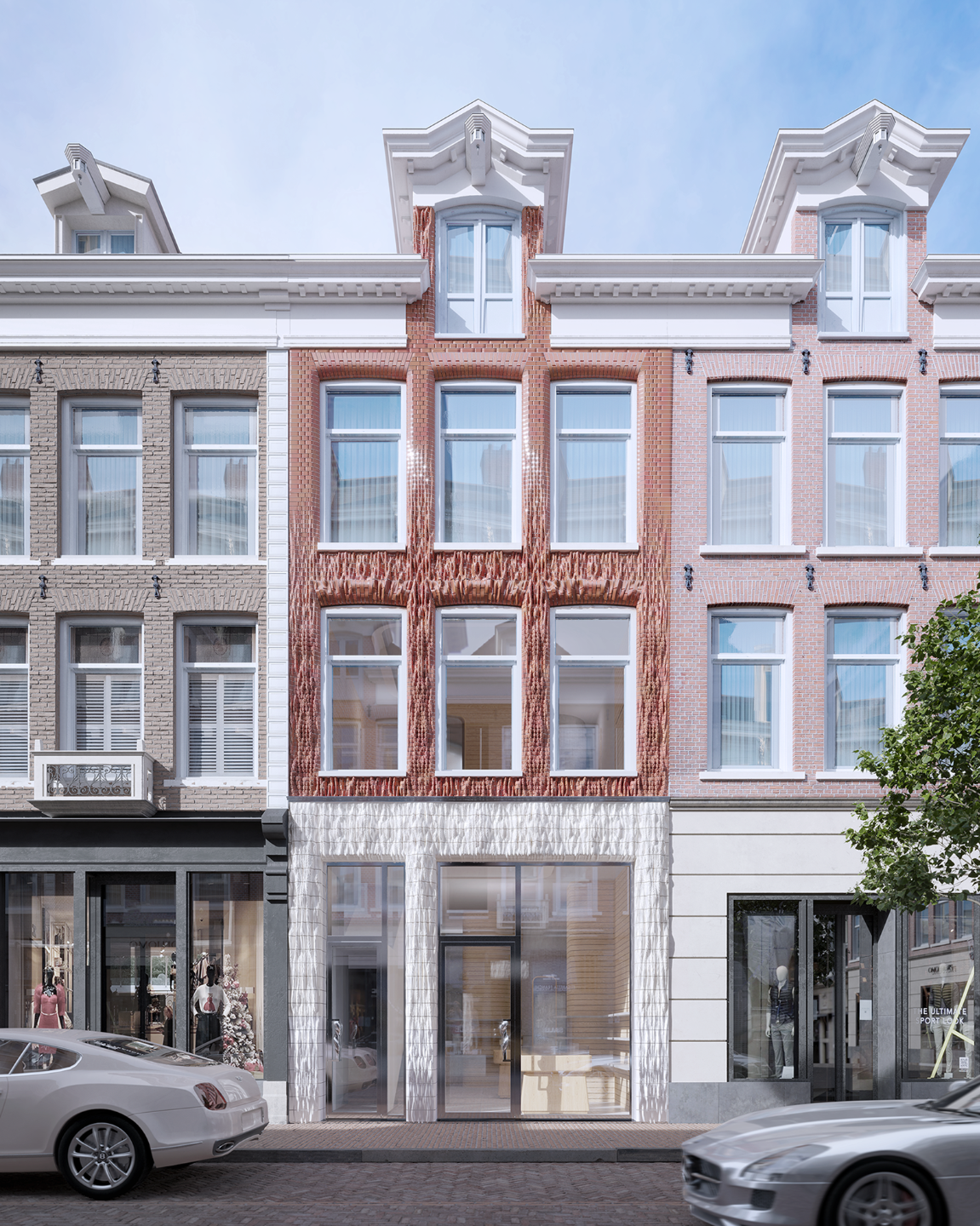
While TECLA represents full-scale 3D-printed housing, the Ceramic House shows a different approach: using a 3D printer to create intricate clay tiles for façades. These components offer complex textures and dimensionality that are hard to achieve with traditional materials. In fact, tile- and brick-style 3D printed elements are already widely used in interior architecture—and they’re quickly making their way into exterior design as well.
Curious about what 3D printing looks like when scaled to architectural environments? Check out our samples through the link!
Did this help? and share it with your friends. Did something come to mind? Got a question? Let the author know. New to Conc? Conc is making tools for people who work with materials.