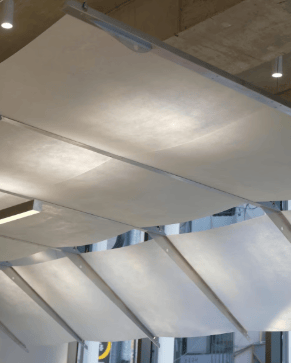
Find the Right Translucent Panel
Shimmering, hazy, almost there but not quite. For when you want light to pass through without revealing everything clearly on the other side.
August 16, 2026
Shimmering, hazy, almost there but not quite. Sometimes you want light to pass through without revealing everything clearly on the other side. Translucent materials can create boundaries—partitions, windows, screens—or become luminous surfaces when lit from behind. There are more ways to create a translucent surface than you might think. Choose by the look you want and how you plan to use it.
1. FRP
For translucency with visible texture
FRP reveals the subtle fibers of fiberglass within the surface. Unlike the smooth uniformity of acrylic, its slightly irregular, almost handmade texture gives it character. When illuminated, the fibers become even more pronounced.
See how Imangchi Studio used FRP panels
2. Fabric-Laminated Glass
For a translucent surface with visible weave
Fabric is laminated between layers of glass, combining the strength of glass with the texture, color, and translucency of textiles. A loose weave lets more of what’s behind show through, while a denser weave provides greater privacy.
See linen-laminated glass at Genesis Cheongju
3. Patterned Laminated Glass
For making standard patterned glass look anything but standard
Two different patterned glass panels are layered together. Familiar textures suddenly create an entirely new pattern, shifting as the two layers overlap and misalign depending on your point of view.
See what happens when patterned glass meets patterned glass
4. Hanji Acrylic
For something a little warmer than satin acrylic
If uniform translucent acrylic feels too plain, acrylic laminated with hanji offers a softer alternative. The delicate fibers of the paper remain faintly visible, diffusing light with a paper-like warmth.
Explore hanji and hanji acrylic
5. Satin Acrylic
The go-to translucent panel
Start here when you need a clean, uniform translucent surface rather than a distinctive texture. Lightweight and easy to fabricate, satin acrylic works across a wide range of applications, from small fixtures to partitions.
See satin acrylic used to create a dreamlike interior
6. Patterned Glass
When you need translucency with the strength and materiality of glass
If strength and the feel of real glass matter more than the lightness of acrylic, patterned glass opens up plenty of options. Fluted, rippled, embossed, and other textures each distort light—and the view beyond—in different ways.
Explore glass that blurs the view
7. Polycarbonate
For larger surfaces—or when you need to go outdoors
Lightweight and suitable for large surfaces, some polycarbonate products can also be used for exterior applications. Multiwall polycarbonate is particularly distinctive: its repeating internal cell structure becomes part of the visual texture of the surface itself.
See polycarbonate create its own blur effect
If You Need to Choose Quickly
Clean and simple → Satin acrylic
Texture matters → FRP
Soft, fibrous texture → Hanji acrylic
Visible weave → Fabric-laminated glass
Strength matters → Patterned glass
Something more distinctive → Patterned laminated glass
Large-scale or exterior use → Polycarbonate
Find a Translucent Material That Fits Your Needs
I want light to pass through while maintaining privacy
I need something lighter than glass
I’m looking for translucency with texture
I want to backlight the surface
It needs to work outdoors
Working on a project right now?
Upload a reference image or describe your project requirements, and Conc can help you explore translucent materials that could work for your space.
Did this help? and share it with your friends. Did something come to mind? Got a question? Let the author know. New to Conc? Conc is making tools for people who work with materials.